Reirradiation
The aim of the reirradiation WP is to create guidelines and standardized reirradiation nationally.
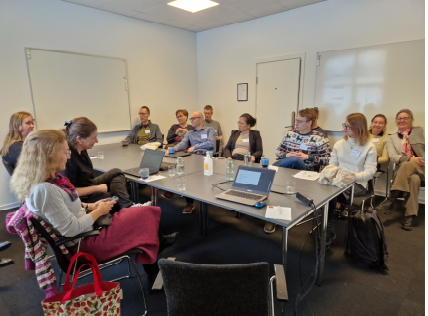
Meeting at DCCC RT annual meeting – establishing the WP
Publications
- A comprehensive national audit of radiotherapy retreatment numbers, sites and indications: https://pubmed.ncbi.nlm.nih.gov/40629921/
- Clinical workflow for reirradiation: national consensus recommendations on imaging, treatment planning, dose accumulation, and treatment delivery: https://pubmed.ncbi.nlm.nih.gov/40704773/
Introduction and aim
In 2023, a national group of oncologists and medical physicists was established under DCCC-RT. This group has established a subgroup to prepare a clinical study to collect dose schedules and clinical data for patients offered reirradiation. The study will be open to patients in all Danish DMCGs and is intended as an observational study with registration of clinical data collected either from clinical visits or from patient-reported side effects. During study development, it will be investigated which clinical parameters are essential and which data would be advantageous to collect, thereby providing the individual DMCGs with guidelines for collecting data.
Based on this, a RedCap database will be built for the collection of clinical data both from previous radiotherapy and systemic treatment (via medical records at patient inclusion) and current reirradiation (via patient visits and/or patient-reported side effects). Specifically, for patients with curatively intended radiotherapy, we will at least collect data for serious (grade 3-5) radiation-related side effects. The study will also, as far as possible, collect data for survival and local control.
The study will be open for inclusion for 5 years and 100 patients per year from all eight Danish radiotherapy clinics are expected to be included.
As part of the study, we will prepare guidelines for dose summation. Currently, there are no guidelines on how this is done. Dose summation is sensitive to anatomical changes, and there can be very large differences in the outcome of the summation depending on how it is performed. We will draw up national guidelines for this to standardize the procedure.
Criteria for acceptable dose to the healthy tissue can be determined by comparing clinical data for side effects with the summed dose for the two radiation treatments. After completion of the study, we will collate this data to gain knowledge of the relationship between delivered dose and serious adverse effects, so that we can establish dose restrictions that ensure acceptable side effects. Another goal is to standardize reirradiation nationally, which is ensured by having uniform methods for patient inclusion, dose summation, healthy tissue dose limits and side effect registration.
Background
The number of patients receiving reirradiation with either curative, life-prolonging or pain-relieving aims is increasing. Some of the patients have previously been treated with high-dose radiation therapy. Unfortunately, a proportion of these patients experience localized recurrence of their tumour, or they develop a new tumour near the previously irradiated area. Some patients will benefit from new high-dose radiotherapy with curative intention. However, there is a high risk of serious, even fatal, side effects when repeated radiotherapy is given in the same area. The literature in the area is limited to small studies with a median of 40-50 patients, and there are no fixed criteria for the dose limits to the surrounding healthy tissue. Nationally and internationally, a huge variation in the number of patients being offered reirradiation and the dose/fractionation scheme being used, are seen.
Correspondingly, some patients will benefit from reirradiation in a palliative regimen, possibly in combination with systemic therapy. Some of these patients may survive for several years and may benefit from several repeated radiation treatments of previously irradiated tissue. There is very limited knowledge of how high a total dose can be delivered in a palliative regimen and the impact of systemic therapy on healthy tissue dose limits is largely unknown.
Dose limitation to the healthy tissue can be assessed by comparing the total dose from previous and current radiation plans with the side effects. However, it is time-consuming and complicated to make a full 3D summation of the two doses, and it is rarely done in clinical practice. Often only a simple summation is made, where the maximum dose is estimated. However, it is possible to make a full 3D summation by transferring the dose from the first treatment to the CT scan for the retreatment. This can be done prospectively or retrospectively, if dose plans and side effect data are available, to extract the summed dose and compare this with registered side effects.
Projects
The aim is to create guidelines and standardized reirradiation nationally.
- Creating guidelines for image registration and dose accumulation across anatomical sites
- Get an overview of how many patients are treated at the individual clinics. Preferably calculated in relation to site, dosimetric overlap, curative/palliative intention
- Investigate whether it is possible to set up constraints that are independent of diagnosis
- Make guidelines for recovery and α/β
- Support the collection of dose plans nationally. This includes ensuring a consistent nomenclature, which, however, must preferably be centre-specific
- Establish which clinical parameters can be collected for first and second irradiation, including PROM. A simple registration of tox and death can mean that clinics will be less reluctant to give curative reirradiation.
- Create guideline for QA for dose accumulation, guideline for what data is necessary to collect in order to assess reirradiation. These guidelines were started during a previous national workshop on dose accumulation and reirradiation
- Establish a forum for knowledge sharing where we can share knowledge about new measures in the area
- Investigate the possibility of doing a national prospective registration study across diagnoses. It could be a basic protocol that can basically contain all possible patient categories
WP leaders
Heidi S. Rønde (Danish Centre for Particle Therapy) and Lone Hoffmann (Aarhus University Hospital)

PRIOR steering committee members
DCPT: Camilla Kronborg (chair) & Heidi S. Rønde
AUH: Jesper Grau Eriksen & Lone Hoffmann
AAUH: Weronica Szejniuk & Martin Skovmoes Nielsen
OUH: Tine Schytte & Morten Nielsen
Vejle: Else Maae & Jakob Boll Overgaard
RH: Mette Pøhl & Ane Appelt (vice chair)
Herlev: Filippa Sundbye & Laura Ann Rechner
Næstved: Joanna Szpejewska & Laura Kaplan
Members
Aalborg University Hospital
Weronika Maria Szejniuk (physician), Hella Maria Brøgger Sand (physicist), Martin Skovmoes Nielsen (physicist), Laurids Østergaard Poulsen (physician), Steffen Vestergaard (physicist)
Aarhus University Hospital
Jesper Grau Eriksen (physician), Birgitte Offersen (physician), Hjørdis Hjalting Schmidt (physician), Stine Overvad Fredslund (physician), Elizaveta Tabaksblat (physician), Slavka Lukacova (physician), Lone Hoffmann (physicist), Jolanta Hansen (physicist), Mai-Britt Linaa (physicist), Tine Bisballe Nyeng (physicist), Esben Worm (physicist), Anne Ramlov (physician), Brita Singers Sørensen (biologist, professor), Hanne Krogh Rose (physician), Line Schack (physician), Lise Mortensen (physician), Maja Bendtsen Sharma (physician), Marianne Sanggaard Assenholt (physicist)
Danish Centre for Particle Therapy
Camilla Jensenius Skovhus Kronborg (physician), Hanna Rahbek Mortensen (physician), Kenneth Jensen (physician), Morten Høyer (physician), Heidi S. Rønde (physicist), Maria Fuglsang Jensen (physicist), Stine Elleberg Petersen (physician), Ulrik Vindelev Elstrøm (physicist), Kari Tanderup (physicist, professor)
Vejle Hospital
Torben Schjødt Hansen (physician), Mikkel Drøgemüller Lund (physicist), Christine Madsen (physician), Else Maae (physician), Jakob Boll Overgaard (physicist), Rune Thing (physicist), Kristina Nielsen (physician)
Odense University Hospital
Tine Schytte (physician), Lotte Holm Land (physician), Morten Nielsen (physicist), Irene Hazell (physicist), Anni Young Lundgaard, Kristine Skovly Nielsen, Simon Krogh (physicist), Rana Bahij (physician)
Næstved Hospital
Marco Bebec (physician), Vladimira Horvat (physician), Saskia Esser-Neumann (physician), Laura Kaplan (physicist), Dorte Yakymenko (physician)
Herlev Hospital
Gitte Persson (physician), Filippa Sundbye (physician), Mette van Overeem felter (physician), Bodil Elisabeth Engelmann (physician), Katarina Wiviann Ottosson (physicist), Laura Ann Rechner (physicist), Anna Mann Nielsen (physician), Claus Behrens (physicist), Patrik Sibolt (physicist)
Rigshospitalet
Mette Pøhl (physician), Rebecca Tobin (physicist), Cecile Peucelle (physicist), Daniella Østergaard (physician), Isak Hannes Wahlstedt (physicist), Lotte Nygård (physician), Vibeke Nordmark Hansen (physicist), Ane Appelt (physicist, professor)
SUH Roskilde
Joanna Eliza Szpejewska (physician)
-
Esben Schjødt Worm
Medical Physicist, PhD
Aarhus University Hospital![]()
-
Morten Høyer
Chief physician, professor
Aarhus University Hospital![]()
-
Irene Hazell
PhD
Odense University Hospital![]()
-
Jesper Grau Eriksen
Professor, overlæge, PhD
Aarhus University Hospital![]()
-
Lone Hoffmann
PhD, clinical associate professor
Aarhus University Hospital![]()
-
Heidi S. Rønde
Hospitalsfysiker
Aarhus University Hospital![]()
-
Kenneth Jensen
MD, clinical associate professor
Aarhus University Hospital![]()
-
Hella Sand
Hospitalsfysiker
Aalborg University Hospital![]()
-
Slavka Lukacova
MD, PhD
Aarhus University Hospital![]()
-
Hanna Rahbek Mortensen
MD, clinical associate professor
Aarhus University Hospital![]()
-
Gitte Persson
MD, Professor
Herlev Hospital![]()
-
Tine Schytte
Chief physician, Associate professor, PhD
Odense University Hospital![]()
-
Laura Patricia Kaplan
Physicist, PhD
Zealand University Hospital, Næstved Sygehus![]()
-
Laura Ann Rechner
Medical Physicist, PhD
Herlev Hospital![]()
-
Mette van Overeem Felter
MD, PhD
Herlev Hospital![]()
-
Birgitte Vrou Offersen
Professor, MD
Aarhus University Hospital![]()